
From side-hustle to travel brand in nine days.
How Maya B., a Viago ambassador specializing in honeymoon and romance travel, went from a link-in-bio page to a professional website with an organized pipeline behind it — as part of the Horizons OS founding pilot.

Maya B. · Honeymoon & romance travel · Founding pilot member
Results from our private partner pilot. Individual results vary with niche, audience, and effort.
The starting point
Maya had the hardest part figured out: people trusted her. Friends, followers, and referrals kept asking her to plan their honeymoons. What she didn't have was anywhere credible to send them. Her "website" was a link-in-bio page, her CRM was a notes app, and her follow-up system was memory and good intentions.
Inquiries arrived through Instagram DMs, text messages, and a form that emailed her — sometimes. When a couple asked "can I see your website?", the honest answer was no.
The build: nine days, five steps
Maya joined the Horizons OS pilot on a Monday. Her workspace was live the same day, with the website questionnaire waiting on her dashboard. She spent about forty minutes on it — her niche, her story, the trips she loves planning, the couples she wants to attract.
From there, the process ran on rails. Our team built her draft; she reviewed it inside her workspace and requested revisions — tighter copy on the homepage, a warmer photo direction, a dedicated honeymoon planning page. Every step showed its status on her dashboard, so she never had to email anyone to ask "where are we?"
Questionnaire to launch.
Workspace live, questionnaire in
Maya's private workspace was provisioned at signup. She completed the guided brand questionnaire the same evening.
Draft designed and built
The Horizons OS team designed her site around her niche and voice — structure, copy, and imagery direction included.
Revisions, tracked in-workspace
Maya requested two rounds of refinements from her dashboard and watched each one move from "requested" to "done."
Review call
A scheduled walkthrough — booked through her own Horizons OS calendar — to approve the final build together.
Launch-ready
Domain connected, lead capture wired to her CRM, booking link live. Maya announced her site that weekend.
What changed after launch
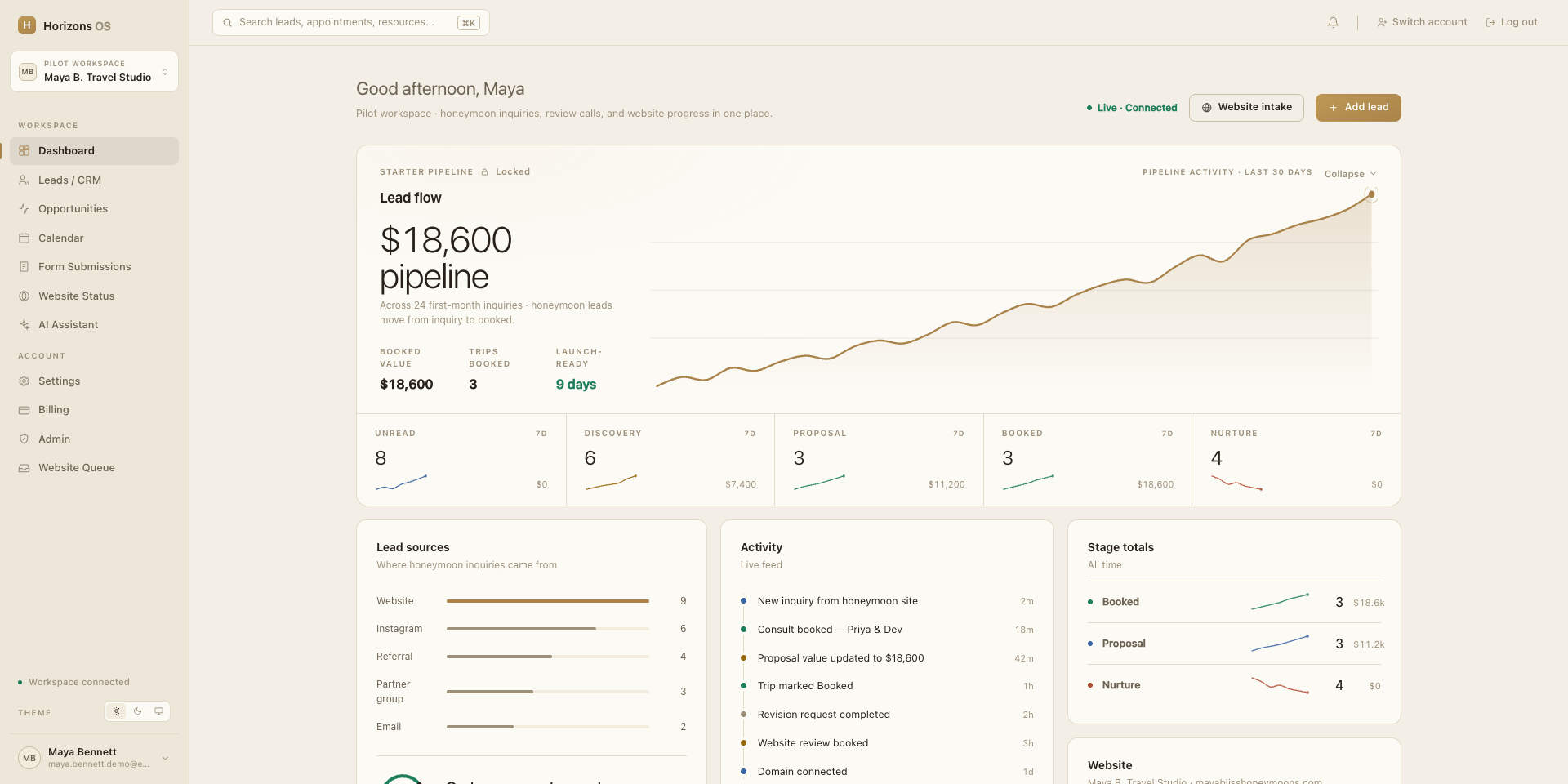
The website was the visible win — but the workflow underneath it changed how Maya works. Inquiries from her site now land directly in her CRM with trip details attached. Discovery calls book against her real Google Calendar availability, with a two-day buffer so nothing ambushes her. Every couple moves through the same pipeline: inquiry, discovery, proposal, booked.
The quiet difference is what's gone: the spreadsheet, the notes app, the screenshot-a-DM-so-you-don't-forget system. When she opens her dashboard in the morning, she knows exactly who's new, who's waiting on her, and what's on the calendar.
The takeaway
Maya's story is the pattern the pilot was designed to prove: ambassadors and independent advisors don't need more tools — they need one system where the pieces already know about each other. A website that feeds a CRM. A CRM that feeds a pipeline. A pipeline that books onto a real calendar. That's the product.